



Difference Between Asthma and COPD: Key Differences You Should Know


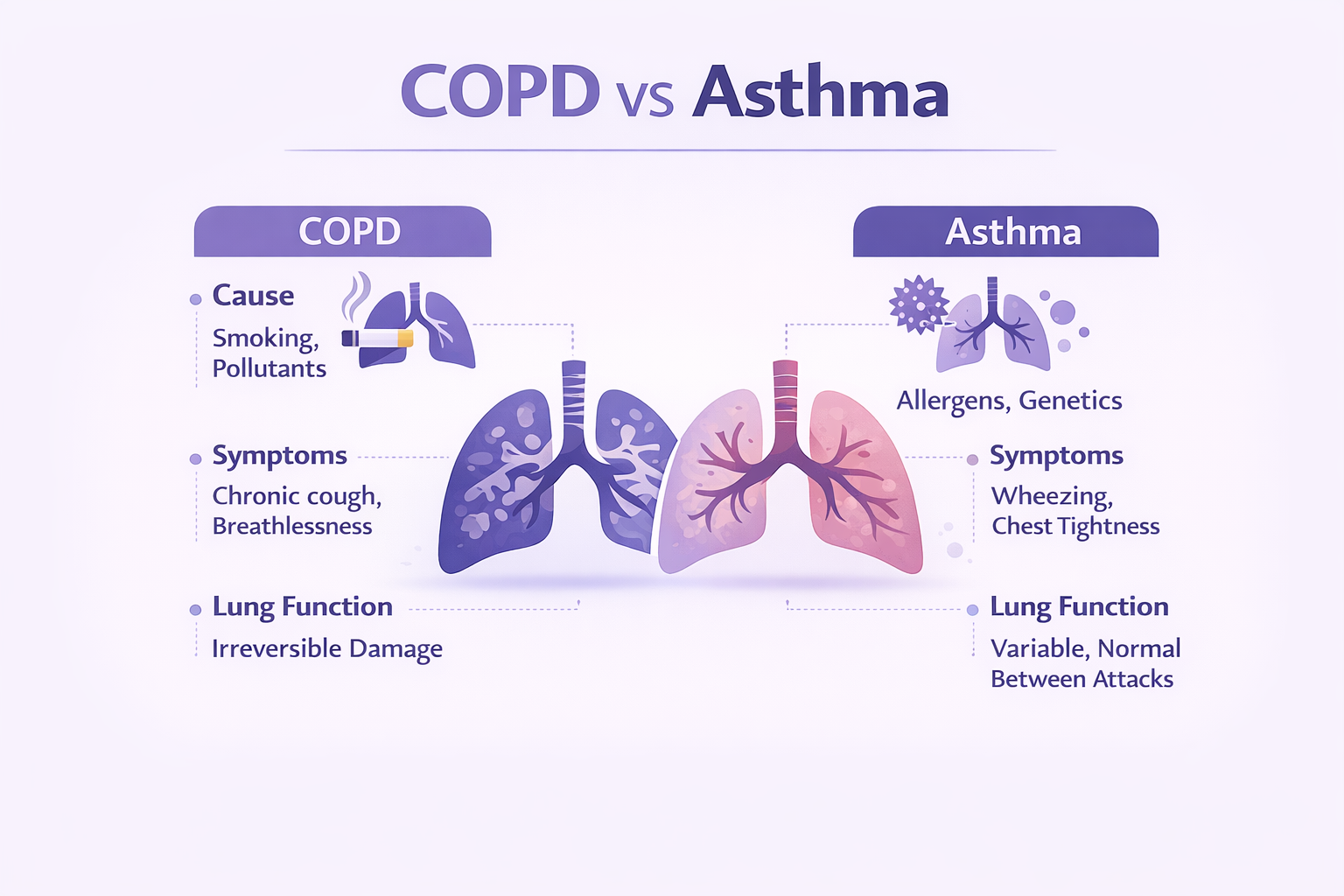
Table of Contents
Most often than not, chronic symptoms such as breathlessness, wheezing, or persistent cough causes people to pin down their search for either asthma or chronic obstructive pulmonary disease (COPD). While both the conditions are known to impact your respiratory pathway, their causes are poles apart. While asthma is usually caused due to an allergic trigger, COPD can be caused due to chronic smoking or inhalation of smoke (biomass or challah). Unlike COPD which mostly affects people in the later stages of life, asthma affects people across all age groups, including children.
Here’s everything you need to understand including the difference between asthma and COPD, right from its causes and symptoms to management approaches.
Asthma vs COPD: The Key Differences
While both asthma and COPD are chronic inflammatory lung diseases, they are completely different disorders. Asthma is caused due to a hyper-responsive immune system which overreacts to triggers such as pollen, pet danger, dust, or a vigorous run. It leads to temporary, reversible narrowing of the airways which causes the symptoms such as wheezing, breathlessness, and cough. It usually begins in childhood followed by a long symptom-free intervals between flare-ups.
On the other hand, chronic obstructive pulmonary disease, is caused due to years of toxic exposure to smoke mostly from cigarettes, coal, wood-fire "chulha," smoke and industrial dust. This causes a gradual scarring of the airways and destroy the air sacs. It usually starts after the age of 40 with symptoms that include thick phlegm, daily "smoker's cough," and breathlessness from walking across the room to stair climbing.
| Feature | Asthma | COPD |
|---|---|---|
| Typical age at start | Childhood or teens (can start at any age) | > 40 years, after long-term exposure to causative agents |
| Main causative agent | Allergic or irritant triggers set off aggressive immune reaction | Damage from tobacco, biomass smoke & industrial pollutants |
| Airway narrowing - reversible/non-reversible | Reversible with reliever inhaler or steroids | Partly irreversible because structural lung damage limits full recovery |
| Symptom pattern/s | Episodic coughing (at night or with exercise), wheezing, and chest tightness, often triggered by allergens or physical activity | Daily breathing difficulty and morning coughing with phlegm |
| Flare triggers | Pollen, pets, viral colds, cold air and exercise | Chest infections, continued smoking and winter smog |
| Long-term outlook | Usually stable if triggers avoided and inhalers used correctly | Gradual decline; can be slowed but not reversed |
| Classic preventive step | Allergen avoidance + use of inhaled corticosteroid | Quit smoking + pulmonary rehabilitation |
| Overlap possibility | Asthma–COPD overlap seen in older smokers with childhood asthma history |
It is important to differentiate between asthma and COPD for appropriate treatment. Understanding the differences between asthma and COPD might help you discuss your symptoms better with your healthcare provider. In turn, accurate diagnostic tests and appropriate medicines are prescribed to manage your condition.
Symptoms: Overlapping Yet Distinct
| Symptom/s | Asthma | COPD |
|---|---|---|
| Wheezing | Often at night, early morning, or following a sprint, loud, musical wheeze that originates in sudden bursts | Possibly present, but less whistly; many COPD sufferers claim more "chest crackles" than actual wheezing |
| Breathlessness | Usually brought on by allergies, cold air, exercise, or stress, shows in brief, dramatic episodes often quickly corrected with a reliever inhaler | Climbing stairs or shopping could feel like a marathon; gradually, daily shortness of breath gets worse over years |
| Cough | Usually dry and irritable; flares at night or following dust or pollen exposure | Constant "smoker's cough" in the morning especially that brings up sticky mucus |
| Variation in symptoms | High variability: many days free of symptoms between asthma bouts | Low variability: symptoms show consistent decline instead of sudden changes |
| Common triggers | Typical causes are pollen, pet fur, viral colds, high trigger sensitivity exercise | Cigarette smoke, biomass fumes, winter smog, chest infections (damage already present) |
Diagnostic Approach: How Tests Help Tell Them Apart
Telling asthma from COPD starts with a comprehensive profiling of your symptoms and exposures followed by certain lung tests to determine how and why your airways are struggling.
| Diagnostic Tool | What It Checks | Typical Asthma Finding | Typical COPD Finding | Why It Matters |
|---|---|---|---|---|
| Spirometry | Your FEV?, FVC, how quickly and how much air your blow out | Big jump (? 12 % & 200 mL) in FEV? following a bronchodilator—proof of reversibility | Little or no change following a bronchodilator—airflow limitation is fixed | First-line test for asthma vs COPD diagnosis |
| Bronchial Provocation, also known as Methacholine Challenge | “twitchiness” in aiways | Airways narrow at very low doses—high hyper-responsiveness | Usually either normal or only minor constriction | Applied when spirometry shows normal, but asthma still suspected |
| Full Pulmonary Function Test (PFT) | Lung volumes and gas transfer | Volumes usually normal between attacks; diffusion (DLCO) normal | Air trapping, high residual volume, low DLCO in advanced disease | Severity of disease and for long term care plan |
| X-ray/CT scan of chest | Structure of the lungs and diaphragm shape | Typically normal; occasionally, during a bad attach, possible transient hyperinflation during a bad attack | Hyper-inflated lungs, flat diaphragm | Helps in ruling out infection etiology, heart disease, and highlights COPD vs asthma pathology |
| Blood tests | Risk related to Inflammation or genetic | Elevated eosinophils or IgE point to an allergic pattern | Test for alpha-1 antitrypsin deficiency in younger COPD cases | Aids in customizing inhaler selection and spot rare causes |
| Symptom or Peak-Flow Diary | Day-to-day change in airflow | Big ups & downs (at least 20 %) indicates asthma | Numbers remain low and flat | Simple home tool to document asthma vs COPD airflow variation |
It is important to consult your doctor before taking any of these tests. They will prescribe the necessary tests based on your symptoms and clinical history and explain any precautions to be taken or any medications to take/stop before the tests.
How doctors put the puzzle together
- Clinical history like childhood allergies or pet triggers raise asthma flags, whereas decades of smoking steer towards COPD.
- Spirometry with reversibility is the cornerstone. One five-minute blow test can distinguish a flexible asthmatic airway from a stiff COPD airway.
- Provocation tests (methacholine) catch “hidden” asthma when baseline results look normal.
- Imaging either helps in ruling out surprise culprits like heart failure and tuberculosis or confirms lung damage due to COPD.
- Targeted blood work for fine-tuned treatment. High eosinophils signal steroid-responsive asthma, whereas a low alpha-1 antitrypsin betrays a rare genetic COPD.
Combining these hints will help your doctor to decide which inhaler and which strength of inhaler to use. Also, it helps them to decide whether medicines for allergies are needed or not.
Treatment Differences: Managing Asthma vs COPD
Since the problems in the lungs caused by asthma and COPD are different, they need separate management plans.
| Management Area | Asthma | COPD |
|---|---|---|
| Main goal | Calm airway inflammation & stop sudden attacks | Slow down the decline of lung function & ease everyday breathlessness |
| Core medicines | Inhaled corticosteroid (ICS) daily; your doctor might add a Long-acting beta agonists (LABA) if symptoms persist | Long-acting Beta Agonists (LABAs) or long-acting Muscarinic Antagonists (LAMAs) is the first line of treatment. Inhaled corticosteroids (ICS) are only added for frequent flare-ups or high eosinophil count |
| Quick-relief inhaler | Short-acting beta agonists (SABA) for immediate wheeze control | Short-acting Beta Agonists (SABA) for rescue, but effect is mild |
| Rehabilitation | Usually not required if asthma is well-controlled | Pulmonary rehab - exercise training, breathing techniques & nutrition advice - improves stamina & quality of life |
| Lifestyle focus | Avoid or reduce triggers like dust, pollen, pets & strong smells | Quit smoking, avoid exposure from biomass-fume, use masks during winter |
| Vaccinations | Annual flu and pneumococcal vaccines to reduce attack risk | Vaccines like flu and pneumococcal along with pertussis booster is recommended in some guidelines |
Common must-dos include to stay physically active, eat a balanced and healthy diet as recommended by your doctor and consult a doctor if rescue inhalers are needed more than twice a week.
Conclusion
Asthma and COPD are both diseases of the lungs; however, both are different. They have different causative factors, symptoms, and management strategies. COPD is a long-term long damage to the lungs whereas asthma is often reversible, driven by triggers. Spirometry, listing down the symptoms, and the appropriate scans can help in identifying the exact condition. This helps doctors to prescribe appropriate medicines and inhalers and suggest lifestyle changes. Know the difference, work with your doctor, and you’ll breathe easier, dodge flare-ups, and protect your lungs for the long haul.
References
- Asthma and Chronic Obstructive Pulmonary Disease (COPD)
- Comparison of clinical features and management of asthma and COPD - European Review for Medical and Pharmacological Sciences
- Chronic Obstructive Pulmonary Disease (COPD). WHO
- Asthma. WHO
- Asthma and COPD Overlap. National Library of Medicine
- Asthma-COPD coexistence. The Journal of Allergy and Clinical Immunology
Disclaimer
This content is intended for general educational and informational purposes only. It is not a substitute for professional medical advice, diagnosis, or treatment.
Rate the article

Comments